Continuous governance in Iden reads every connected app every 2 hours: who holds an account, what that account can do, and when it was last used. It reads the app itself rather than assuming from what Iden last provisioned, because the two drift, and the drift is where the findings are.
Governance after the fact tells you what went wrong last quarter. The point of doing it continuously is to find out while it is still cheap.
90 days is a long time not to be looking
A user access review is periodic by nature, and everything between two of them is unwatched. An entitlement granted the day after a cycle closes goes unexamined for 89 days, and the review that eventually sees it is looking at something 3 months stale.
That is the structural limit of certification as a control. It is a snapshot, and the thing it governs is a film.
So most of the work should happen before the review opens, and the review becomes the attestation on top of work already done.
What runs between reviews
Iden correlates each read against the systems that hold the truth about people. The HRIS says who is employed, in what department, and whether they left. The IdP says who can authenticate and which groups they are in.
Access with no matching employment record is a different finding from access with no matching group. You can only tell them apart if you are reading all 3 sources at once.
What continuous governance looks for
The analysis looks for a small number of specific shapes.
- An orphaned account belongs to someone terminated in the identity source who still holds accounts in apps. It is the offboarding that did not finish, and usually the largest category on a first scan.
- An overprovisioned account has more access than the role accounts for, whether it accumulated across role changes or was granted once and never removed.
- A third-party account belongs to an external person. These are the least reviewed, because they are on no manager's team.
- A zombie account is a live credential nobody has used in months.
- A new privileged account means somebody gained admin since the last scan, which is worth knowing within hours rather than at the next quarter.
- A separation of duties violation is checked per app and per rule, because the conflicting pair in Salesforce is not the one in NetSuite.
Findings arrive as an inbox
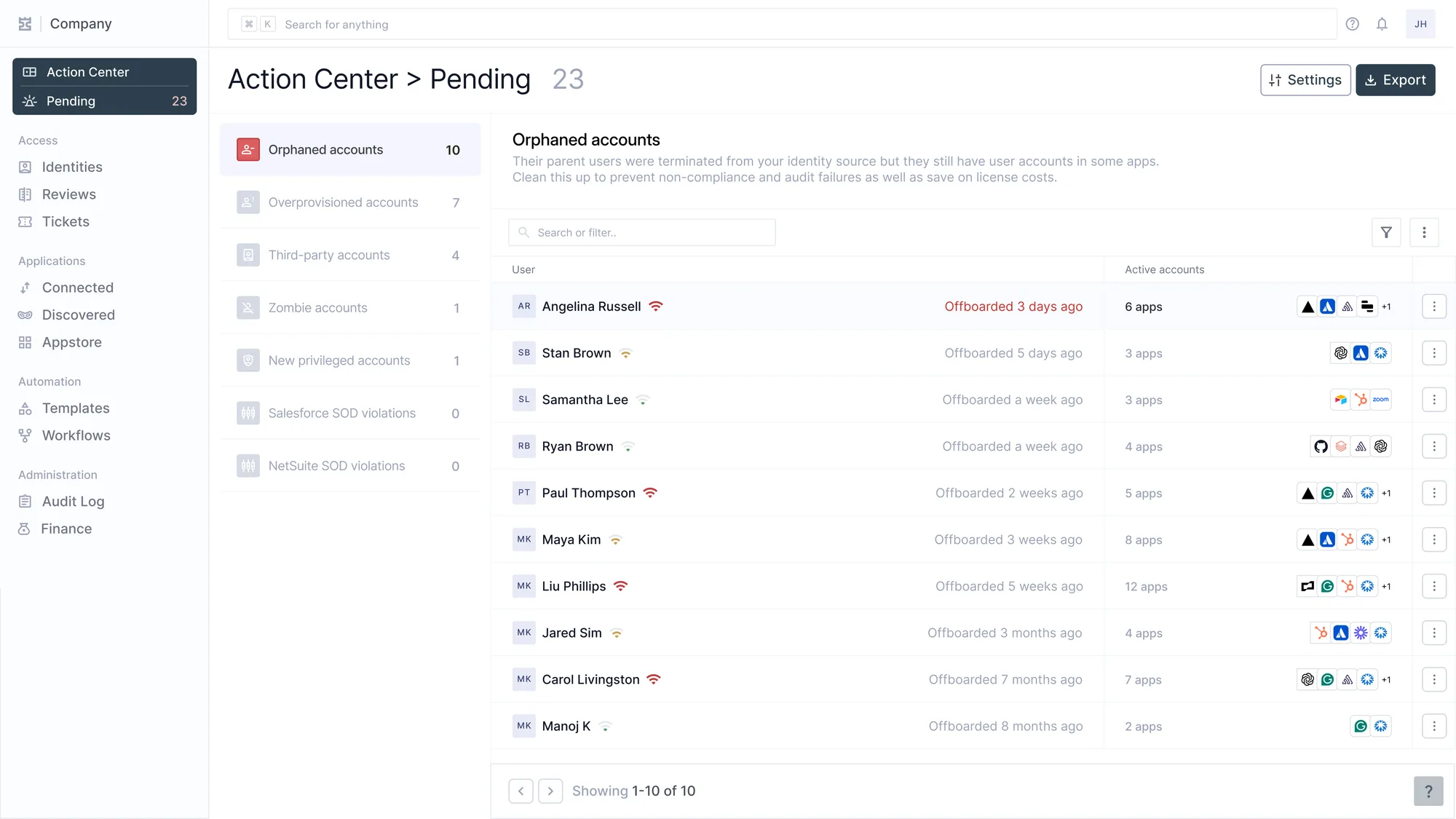
Findings as an inbox. Categories and counts on the left, the queue on the right, and two categories already at zero. Angelina was offboarded three days ago and still holds six apps.
Inbox zero is the design goal, and that is a deliberate choice. A dashboard shows you a number and asks you to feel something about it. An inbox gives you a queue with an end, and the end is reachable.
Categories are on the left with their counts and the queue is on the right. 2 of the categories in that screen are already at zero, which is the state the whole thing is pointed at.
Age is on every row, and the recent ones are marked. Angelina was offboarded 3 days ago and still holds 6 apps. Manoj was offboarded 8 months ago. Those are different problems: the first is a process that just failed, the second is inherited. Ranking by count alone buries the one that happened this week under 25 that came with the estate.
Nothing in the queue blames you for what you inherited. Findings that existed when Iden first connected are marked as inherited and kept out of the open count. A tool that opens by telling an admin they have 300 failures they did not create is a tool they stop opening.
Closing a finding does not always mean fixing it
There are 3 ways to clear a finding, and only one of them is removal.
- Fixed at source means the access is gone, and so is whatever granted it, so the finding does not come back next scan.
- Excepted, with an expiry, means the access is correct, and the record says who says so and until when. A named exception with a date is a governance artefact. An ignored finding is not.
- Reviewed means somebody looked, decided, and recorded the decision. An admin often cannot remove access because a business owner says no, and the honest thing is to credit that decision rather than pretend the queue is a to-do list of things the admin controls.
The second and third are what make inbox zero reachable. If the only way to clear a row were to delete something, the queue would never empty and nobody would try.
Every one of those closures is recorded: what triggered the finding, how it was resolved, and by whom. The record is mapped to SOC 2 CC6.1 through CC6.3 and ISO 27001 A.9 and exportable per control, so the evidence is written while the work happens.
What happens to the quarterly review
The cycle stays. Most frameworks want a named person attesting on a schedule, and continuous checks do not satisfy that on their own.
What changes is what arrives in the campaign. A reviewer opening one that continuous checks have already cleaned sees judgement calls at a volume they can read, instead of 400 rows of which 390 are obviously fine.
What actually changes
What still needs a person
Thresholds stay with you: how long unused is too long, which apps warrant tighter checks, and what counts as overprovisioned in your organisation. Defaults get you started and will be wrong in ways only you can see.
So do the exceptions. Every one of them is somebody deciding that access which looks wrong is correct, and that decision cannot be automated without becoming a rubber stamp with extra steps.