RBAC vs. ABAC vs. PBAC: An Honest Comparison for Teams That Have Outgrown Simple Roles
RBAC breaks at scale. ABAC is powerful but hard to debug. PBAC is where most real programs land. Here's an honest breakdown of all three - with a decision guide.
11 min read · Last updated August 2026
Most access control conversations start with RBAC because it's the easiest model to explain. Assign a role, bundle some permissions, done. But somewhere between 50 employees and 500, that simplicity quietly turns into a liability - and the team that built the role structure is the last to notice.
This post cuts through the marketing around all three major access models - RBAC, ABAC, and PBAC - defines each clearly, shows where each breaks, and gives you a practical decision guide. No vendor spin. Just the tradeoffs.
See Policy-Based Access Control in Action
Reading about fine-grained policy is one thing; watching it execute is another. The interactive walkthrough below shows how a single policy defines who gets what, for how long, and across which apps - including the ones with no SCIM support.
RBAC: Simple Until It Isn't
Role-Based Access Control grants permissions by assigning users to predefined roles. A role is a named bundle of entitlements: Finance Manager can approve expense reports and view QuickBooks. Assign that role to Emma and David, and they both get the same access instantly.
The appeal is obvious. RBAC is easy to administer, easy to audit, and maps naturally to org charts. When someone moves teams, you swap their role. When a dangerous permission needs to be revoked, you update the role once and every member is immediately affected.
A concrete example: A SaaS company with 80 employees defines Engineer, Product, Finance, Support, and Admin roles. Each maps to a set of app permissions. Onboarding takes minutes. Access reviews are straightforward. This works.
Where RBAC Breaks: Role Explosion
The traditional static RBAC model does not scale. It works fine for a few tens of roles, but as the number of connected systems grows, the number of roles grows as well.
The math is brutal. In a real enterprise: 50 job functions × 20 locations × 10 projects = 10,000 roles. Managing 10,000 roles like Sales-Tokyo-ProjA and Sales-Osaka-ProjB is not governance - it's chaos with a spreadsheet.
An organization with a thousand employees can easily end up with a few thousand roles. The difficult problem of managing a thousand employees gets transformed into the even more difficult problem of managing a few thousand roles.
Large-scale role explosion makes audits slow and error-prone. Least privilege becomes impossible to enforce. Security teams lose confidence in permission data. This is the point where many RBAC systems enter a maintenance death spiral - every new project needs a bespoke role, and every review cycle produces more confusion than clarity.
RBAC was designed to be static, meaning it does not model policies that depend on contextual details including time of day, location, or the relationship between users and resources. That's not a bug in RBAC - it's a design boundary. The problem is when teams try to stretch it past that boundary by creating ever-narrower roles instead of switching models.
Research indicates that most organizations unnecessarily carry a surplus of roles - typically between 40-60% - due to lack of discipline in governance.
ABAC: Powerful, But Respect the Complexity Cost
Attribute-Based Access Control makes access decisions by evaluating attributes - of the user, the resource, and the environment - against a set of policies. Instead of "Emma has the Finance Manager role," the decision engine asks: Is the user's department Finance? Is the document classification Confidential? Is it within business hours? Is the device compliant?
ABAC considers multiple factors, such as user attributes (department, clearance level), environmental attributes (time of day, location), device attributes (device health, patch status), and resource attributes (data sensitivity, data volume).
A concrete example: A healthcare system uses ABAC to allow a clinician to access patient records only when: their department matches the patient's care team, the access occurs during their shift, and the device passes a posture check. No role could capture all three conditions simultaneously without exploding into dozens of variants.
Unlike RBAC, which can suffer from "role explosion" due to the need to create numerous roles for various scenarios, ABAC reduces the complexity by leveraging attributes - leading to fewer roles and more manageable policies.
Where ABAC Breaks: Debuggability and Data Quality
ABAC policies can quickly become complex due to the number of attributes, conditions, and logical combinations. This can lead to policy conflicts, unintended access grants or denials, and difficulty in understanding policy behavior.
Debugging access control decisions in ABAC can be challenging, especially when analyzing dynamic attributes. Without the right tools, you might struggle to determine exactly why a request was allowed or denied.
The data quality problem is equally serious. ABAC decisions depend on clean data - a missing or stale attribute breaks access. If HR hasn't updated a user's department, or if a document is missing its classification tag, the system makes the wrong call.
Different teams invent attributes as they go: one service tags dept=finance, another writes team=fin, another uses department=FIN. Now your policies don't line up.
Difficulty explaining why a decision was made is a real operational challenge. Attributes themselves may be sensitive, creating legal and compliance exposure.
ABAC is genuinely powerful. But it requires a mature attribute management infrastructure, clean identity data, and tooling that can simulate and explain policy outcomes. Teams that underestimate this end up with a system that's harder to audit than the RBAC mess they were trying to escape.
PBAC: The Practical Convergence
Policy-Based Access Control is where most serious enterprise programs land - not because it's a third distinct model, but because it's the practical synthesis of the other two.
PBAC represents a next-generation authorization model that separates decision logic from application code. Rather than relying solely on hardcoded roles or attributes, PBAC uses centralized policies that evaluate context, resource attributes, user attributes, and environmental conditions to make dynamic access decisions at runtime.
PBAC takes central control by using explicit, auditable policies that combine roles, attributes, and direct permissions. The key word is centralized. Instead of access logic scattered across dozens of apps, PBAC defines it once in a policy engine and enforces it everywhere.
A concrete example: A fintech company defines a PBAC policy: "Users with the Payments role may initiate transfers up to $10,000 during business hours from a managed device. Transfers above that threshold require a second approver from the Finance Lead role." That single policy encodes role membership, a resource attribute (amount), an environmental condition (time, device), and a workflow rule - all in one auditable statement.
PBAC enhances enterprise security by translating business logic into enforceable access policies. It works in harmony with Identity Governance and Administration (IGA) systems, evolving them to provide a more complete view of what users are permitted to see, access, or do.
PBAC also supports the principle of least privilege - only the necessary permissions are granted, reducing the chance of unauthorized access. And critically, as regulations evolve, you simply update policies rather than reconfigure entire role hierarchies.
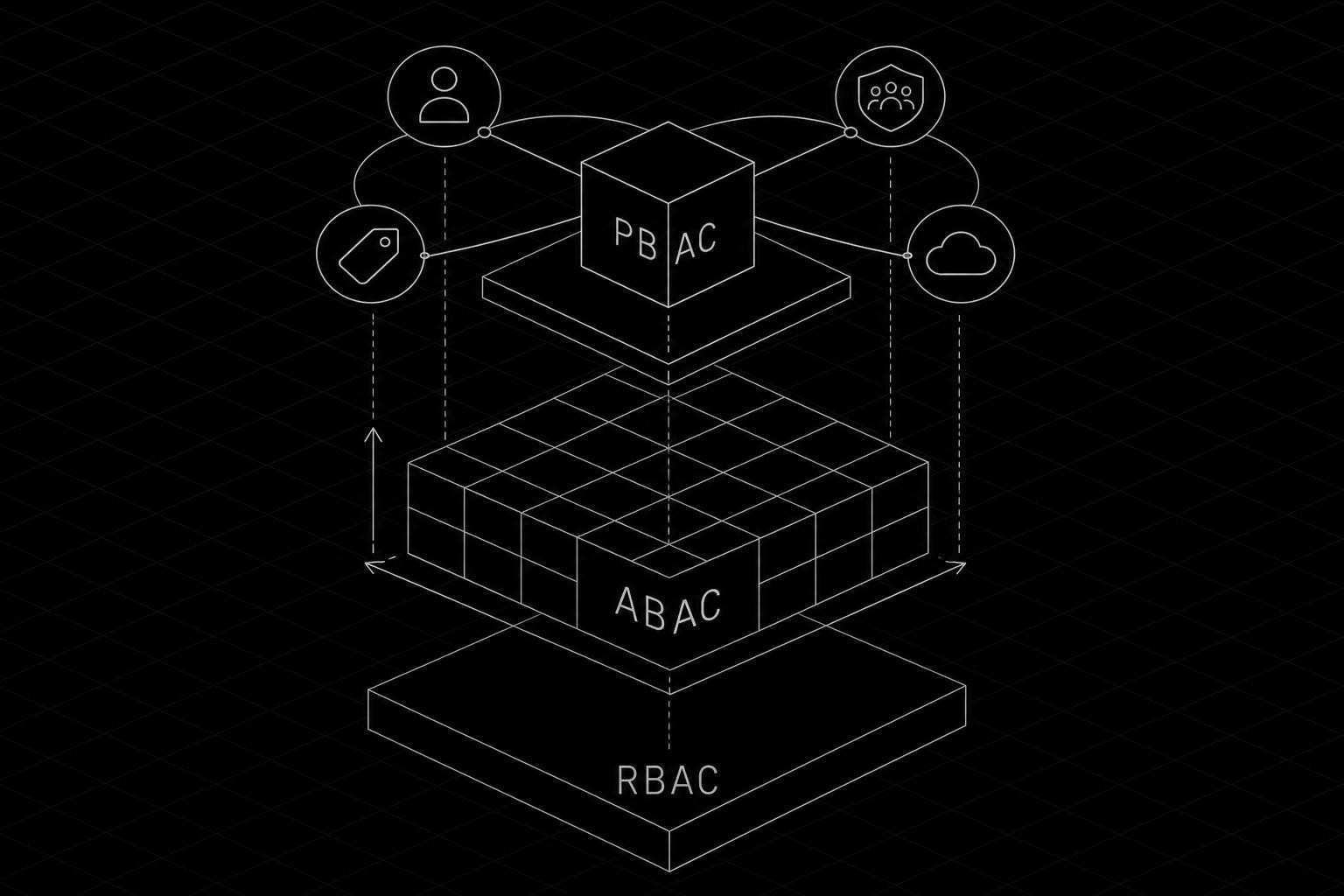
PBAC doesn't replace RBAC or ABAC; it composes them - using roles as one input among many, layering in attributes and context, and expressing the result as a human-readable policy that compliance teams can actually review.
The Comparison Table
| Dimension | RBAC | ABAC | PBAC |
|---|---|---|---|
| How access is decided | User's assigned role(s) | Attributes of user, resource, and environment | Centralized policies combining roles, attributes, and context |
| Strengths | Simple, auditable, easy to onboard | Fine-grained, context-aware, fewer roles needed | Auditable, flexible, maps to business logic, composable |
| Weaknesses | Role explosion at scale, no context awareness | Complex to debug, data-quality dependent, high setup cost | Requires policy governance discipline; initial design effort |
| Best fit | Stable orgs, clear job functions, <200 roles | Healthcare, government, multi-tenant SaaS, data classification | Compliance-driven orgs, SaaS-heavy stacks, hybrid environments |
| Auditability | High — roles are explicit and traceable | Low to medium — dynamic decisions are hard to explain | High — policies are human-readable and centrally logged |
| Least privilege support | Coarse — roles often over-provision | Strong — decisions are contextually precise | Strong — policies enforce minimum necessary access |
| IGA integration | Native — most IGA tools are built on RBAC | Possible but requires attribute pipeline | Native — modern IGA platforms are policy-driven by design |
Most Real Programs Are Hybrid - and That's Fine
The cleanest insight from practitioners who've run access governance at scale: the progression from RBAC to ABAC to PBAC is not about abandoning earlier models - it is about adding expressiveness to handle increasingly complex access requirements without generating role explosion.
RBAC is a great basis for hybrid or advanced access control models. Many organizations apply RBAC to address baseline accessibility and subsequently add contextual controls through PBAC or ABAC for risky actions.
A practical hybrid looks like this: RBAC handles the 80% case - standard job function access, app provisioning, onboarding. ABAC or PBAC layers handle the 20% that needs context - elevated privileges, sensitive data access, cross-team collaboration, time-bound contractor access. PBAC allows you to grant time-bound, task-specific access that expires automatically, reducing the chance of lingering accounts or privilege misuse.
This is also where IGA becomes the connective tissue. AI-powered role mining can continuously refresh RBAC and ABAC postures by combining HR data, entitlements, and behavioral patterns - preventing role sprawl and enabling least privilege. Without an IGA layer enforcing lifecycle events (joiner, mover, leaver), even the best-designed PBAC model drifts. Access accumulates. Policies go stale. The model you designed for least privilege starts granting more than it should.
This is exactly why access model design and Segregation of Duties enforcement belong in the same conversation. SoD rules - which prevent one person from holding conflicting entitlements - are most reliably expressed as PBAC policies, not as role constraints. A role can tell you what someone is; a policy can tell you what combinations are forbidden, regardless of how those entitlements were granted.
For a deeper look at why the underlying platform architecture matters as much as the model you choose, see our Modern IGA vs. Legacy IGA breakdown.
The Role Explosion Problem Is an IGA Problem
It's worth being direct about something: role explosion isn't just an RBAC design failure. It's a governance failure. Overlapping responsibilities generate duplicate roles. Lack of lifecycle management leaves stale roles intact for years. Granular permissions get assigned directly to new roles without reusing a standard template. Legacy roles are never refactored.
Most organizations discover they maintain 40-60% more roles than required - many being temporary roles that became permanent or were created by copy-pasting user rights without checking real access requirements.
The fix isn't always to rip out RBAC and replace it with ABAC. Often it's to enforce lifecycle discipline - deprovisioning stale roles, running regular access reviews, and using role mining to identify consolidation opportunities. That's an IGA function, not a model-switching exercise.
Where PBAC earns its keep is in expressing the intent behind access decisions in a way that survives organizational change. When a policy says "contractors in the EU may access customer data only from managed devices during their contract period," that policy remains valid even as the org chart shifts, new apps are added, and the contractor roster turns over. A role called EU-Contractor-CustomerData-ManagedDevice does not survive the same changes gracefully.
Decision Guide: Which Model Fits Your Situation?
If you prefer a quick reference:
Choose RBAC if:
- You have fewer than 200 roles and stable job functions
- Your apps are well-structured and role-aware
- Your primary goal is fast onboarding and simple access reviews
- You're early in your governance journey and need a foundation
Choose ABAC if:
- Access decisions genuinely depend on resource classification, device posture, or real-time context
- You have mature, clean attribute data from a reliable source of truth
- You're in healthcare, government, or a multi-tenant SaaS environment
- You have the tooling to simulate and explain policy decisions
Choose PBAC (or Hybrid RBAC + PBAC) if:
- You're compliance-driven and need human-readable, auditable policies
- You need to enforce SoD rules that span multiple apps and entitlement types
- Your stack includes apps without SCIM or native role support
- You want access decisions to survive org changes without manual role refactoring
- You're building toward Zero Trust and need continuous, context-aware evaluation
The Bottom Line
RBAC is not broken - it's just bounded. It works well when your organization is small, your role count is manageable, and your access decisions are static. The moment you need context, fine-grained control, or cross-app SoD enforcement, you've hit that boundary.
ABAC solves the context problem but introduces a complexity and data-quality cost that many teams underestimate. It's the right tool for specific, high-stakes scenarios - not a universal replacement.
PBAC is where governance-mature organizations land: centralized, auditable, composable policies that express business intent rather than technical role assignments. Combined with a modern IGA platform that enforces lifecycle events and surfaces policy drift, it's the closest thing to sustainable least privilege that exists in practice.
The access model you choose is only as good as the governance layer enforcing it. Fine-grained policies mean nothing if stale entitlements accumulate unchecked, if offboarding is manual, or if your long-tail SaaS apps sit outside the governance perimeter entirely.
That's the gap Iden closes - policy-driven, fine-grained access governance across your entire stack, including the apps that every other tool leaves unmanaged.
Related reading
Secrets Management vs. NHI Governance: Where Vaults Stop and Identity Begins
A vault secures the secret - it doesn't govern the identity holding it. Here's the gap between secrets management and NHI governance, and why you need both layers in 2026.
Honest Guide to Okta Alternatives for Identity Governance
Okta is best-in-class SSO. But when governance depth, non-SCIM coverage, or cost at scale become the problem, here's an honest look at what to consider instead.
The Honest IAM Buyer's Guide: Best Tools by Category in 2026
A trade-off-first guide to IAM tools in 2026 - SSO, IGA, PAM, CIAM, and directories explained, with honest best-fit profiles for Okta, Entra ID, SailPoint, CyberArk, Lumos, Iden, and more.