The Identity Fabric Explained: What It Actually Is, What It Isn't, and Why Coverage Is the Whole Game
Identity fabric is a design approach, not a product you buy. Here's an honest breakdown of what it means, what analysts actually say, and why coverage gaps make the whole concept aspirational.
8 min read · Last updated September 2026
Every analyst deck from the last two years has "identity fabric" somewhere in it. Vendors have adopted it. Conference keynotes are built around it. And yet most security architects who ask what it actually means in practice get a different answer every time.
So let's be direct: identity fabric is a design approach - an architectural pattern for unifying identity services across a fragmented environment. It is not a product category. It is not something you buy in a single procurement. And a fabric with holes in it isn't a fabric - it's a patchwork.
That last point matters more than any vendor will tell you.
What Analysts Actually Mean by "Identity Fabric"
The term has two main lineages. Gartner uses it to describe an architectural approach that integrates IAM infrastructure, applications, and services - the goal being consistent, seamless access across digital and physical resources regardless of where users or workloads live. KuppingerCole introduced the concept more than five years ago and has since built a full reference architecture around it, treating the fabric as both a producer of identity services and a mesh connecting different IAM components within an organization's infrastructure.
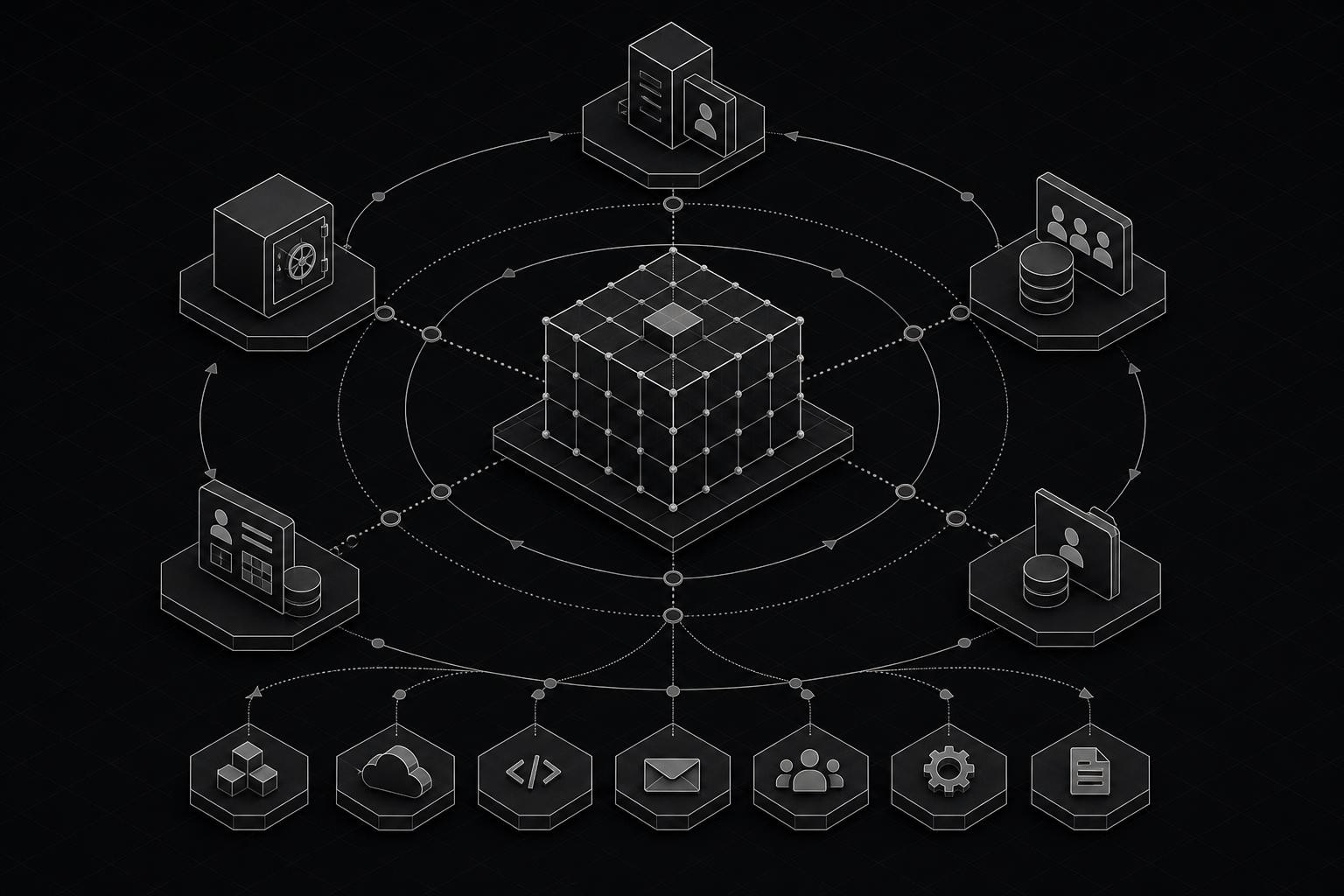
Both framings agree on the core idea: identity fabric is the orchestration layer above your individual tools - the connective tissue that makes IGA, access management, PAM, and ITDR behave as a coherent system rather than independent silos.
Gartner's 2024 IAM Planning Guide put it plainly: identity-first security requires identity fabric approaches to reduce gaps, provide composability and interoperability, and minimize delays in detecting and responding to problems. KuppingerCole's 2025 update placed even greater emphasis on orchestration as the defining capability - the ability to coordinate identity workflows across multiple systems so that provisioning, certification, and access decisions span products seamlessly.
Gartner predicted that by 2027, identity fabric immunity principles will prevent 85% of new attacks and reduce the financial impact of breaches by 80%.
That's the analyst case. Now for the honest version.
The Four Things a Real Identity Fabric Actually Does
Strip away the slideware and a functioning identity fabric has four practical jobs:
1. Orchestration across IdPs and directories The orchestration layer coordinates identity workflows across multiple systems - authentication, authorization, provisioning, certification - so that complex processes span products without custom glue code for every integration. KuppingerCole's 2025 framework treats orchestration as the central capability, not a nice-to-have. Without it, you have a collection of tools, not a fabric.
2. Unified visibility A fabric gives you a single risk view across all identity sources. Today, most enterprises have identity data scattered across an IdP, a PAM vault, an IGA platform, a HRIS, and a growing tail of SaaS apps - each with its own logging format and entitlement model. When identity security is measured tool by tool, governance gaps hide in the seams between systems. A fabric surfaces those seams.
3. Consistent policy enforcement Policy defined once should apply everywhere - not just to the apps your IdP can reach via SCIM, but to every app in the stack. Consistent policy is what separates governance from compliance theater.
4. Lifecycle management across all identity sources Joiner, mover, leaver workflows need to run across every system that holds an identity record - not just the ones that support modern provisioning standards. That includes human identities, service accounts, API keys, and increasingly, AI agents.
What Identity Silos Actually Cost
The alternative to a fabric is the status quo: fragmented IAM tools that each look healthy in isolation while the gaps between them create real exposure.
The numbers are not abstract. IBM's 2025 Cost of a Data Breach Report found that breaches involving compromised credentials took an average of 241 days to identify and contain. That's months of exposure from accounts that should have been deactivated. Fragmented IAM is a direct contributor - when identity data lives in separate systems with no unified view, nobody has a complete picture of entitlement risk.
Nearly 60% of enterprises prioritized consolidating their IAM tools in 2024 to reduce complexity and improve efficiency.
The problem compounds with non-human identities. Machine identities now outnumber human ones by more than 80 to 1 in the average enterprise, and that ratio is projected to widen further. SpyCloud recaptured 18.1 million exposed API keys and tokens in 2025 alone. Service accounts, API keys, OAuth tokens, and AI agents are the fastest-growing, least-governed attack surface in the modern enterprise - and most identity fabrics were designed with human identities as the primary use case.
A 2025 WEF analysis found that 51% of organizations report no clear ownership of AI identities.
A fabric that governs human identities but leaves machine identities unmanaged isn't a fabric. It's a partial solution with a large blind spot.
The Contrarian Point: Coverage Is the Prerequisite
Here's what vendor presentations consistently understate: a fabric with coverage holes isn't a fabric.
The architectural elegance of an orchestration layer, a unified policy engine, and a single visibility plane means nothing if 40-60% of your application estate sits outside it. And for most organizations, that's exactly the situation. SSO handles authentication for the apps that support SAML or OIDC. SCIM provisioning automates lifecycle for the apps that support it. But most apps in a modern SaaS stack don't support SCIM natively - or gate it behind enterprise-tier pricing.
The result: a significant portion of apps and identities, especially contractors, non-SCIM applications, and newly adopted AI tools, are managed manually, inconsistently, or not at all. Those disconnected apps aren't just an inconvenience. With orphaned accounts a leading factor in breach investigations, they represent a structural security risk that no amount of orchestration elegance can fix if the connector simply doesn't exist.
Only 5.7% of organizations have full visibility into their service accounts.
This is the gap between an identity fabric that looks good on a whiteboard and one that actually works. The fabric metaphor is apt: pull one thread loose and the whole thing unravels. An app your governance layer can't reach is a thread you've pulled loose.
The coverage test: Before evaluating any identity fabric approach, map every app in your stack — not just the SCIM-friendly ones. Count the apps your current IGA platform can reach with automated lifecycle management. If that number is below 80% of your stack, your fabric is aspirational, not operational. The governance layer has to reach every app, or the policy gaps it leaves behind will show up in your next access review — or your next incident.
Fabric vs. Point Tools: An Honest Comparison
| Capability | Identity Silos (Point Tools) | Identity Fabric (Orchestrated) |
|---|---|---|
| Policy enforcement | Per-tool, inconsistent | Centralized, consistent across all systems |
| Lifecycle automation | Only SCIM-connected apps | All apps, regardless of protocol support |
| Visibility | Tool-by-tool dashboards | Unified view across all identity sources |
| Non-human identity coverage | Typically absent or manual | Service accounts, API keys, AI agents included |
| Access reviews | Fragmented, manual reconciliation | Automated, cross-system certification |
| Audit readiness | Evidence gathering per system | Single source of truth across the stack |
| Coverage gaps | Structural — apps without SCIM are blind spots | Eliminated only if connectors reach every app |
The Lean-Team Version: What Actually Matters
Most identity fabric content is written for enterprises with dedicated IAM teams and multi-year transformation budgets. If you're running a lean IT function at a 200-1,000 person company, here's what actually matters:
Orchestration without a dedicated IAM team. The orchestration layer has to be operable by a small team. If it requires a professional services engagement to add a connector or modify a workflow, it's not lean-team-friendly - it's legacy IGA with a new name.
Coverage over elegance. A simpler architecture that reaches every app in your stack beats a sophisticated one that misses 40% of it. Prioritize connector breadth before you optimize the policy engine.
Human and non-human in one model. Service accounts, API keys, and AI agents need to be in the same governance model as human identities. Separate programs for human and machine identity create exactly the seams that attackers exploit.
Lifecycle automation that actually closes the loop. Onboarding automation that doesn't cover offboarding isn't automation - it's half a workflow. The fabric has to run the full joiner-mover-leaver cycle across every system, including the ones that don't have a provisioning API.
Governance above the secrets vault. A PAM vault secures credentials. It doesn't govern who should have access to them, whether that access is still appropriate, or what happens when the person who requested it leaves. The governance layer sits above the vault and answers those questions.
For a deeper look at why the architecture choice between modern and legacy IGA shapes everything downstream, see Modern IGA vs. Legacy IGA. And if you're evaluating whether your current platform's SCIM-only approach is leaving coverage gaps, SCIM-Only vs. Universal Coverage in IGA walks through the structural difference.
Is Your Identity Fabric Real or Aspirational? A Readiness Check
Use this widget to assess where your current identity architecture actually stands against the fabric definition - not the vendor's version of it.
The Practical Takeaway
Identity fabric is a useful architectural concept - but only if you hold it to its own standard. A mesh that unifies authentication, authorization, lifecycle, and governance across every identity source and every application in your stack is genuinely valuable. A mesh that does all of that for 60% of your stack while the other 40% stays manual is a marketing claim, not an architecture.
The prerequisite for a real fabric is universal coverage. That means connectors that reach every app - SCIM, API, or neither. It means governance that spans human and non-human identities in the same model. And it means lifecycle automation that closes the loop on offboarding, not just onboarding.
For security architects and platform engineers evaluating identity fabric approaches: start with the coverage map. Count the apps your current governance layer can reach with automated lifecycle management. That number tells you whether you're building a fabric or describing one.
Related reading
Secrets Management vs. NHI Governance: Where Vaults Stop and Identity Begins
A vault secures the secret - it doesn't govern the identity holding it. Here's the gap between secrets management and NHI governance, and why you need both layers in 2026.
Honest Guide to Okta Alternatives for Identity Governance
Okta is best-in-class SSO. But when governance depth, non-SCIM coverage, or cost at scale become the problem, here's an honest look at what to consider instead.
The Honest IAM Buyer's Guide: Best Tools by Category in 2026
A trade-off-first guide to IAM tools in 2026 - SSO, IGA, PAM, CIAM, and directories explained, with honest best-fit profiles for Okta, Entra ID, SailPoint, CyberArk, Lumos, Iden, and more.