An actor's scope should be a consequence of what that actor has done. In almost every deployment it is a consequence of what somebody assumed 6 months ago and never revisited.
Most agent access models are static. The agent has scope X. Some policy granted scope X once, and the agent has had it every session since. The only change happens when someone runs a review, which most teams run quarterly at best, and which produces approve-everything as the default answer.
This is the model Anthropic's framework is gradually moving away from. Part III's continuous authorization. Part IV's Just-In-Time access. Behavioral monitoring as a monitoring layer. Each step takes the static grant and softens it toward something the system can adjust.
The piece that's missing in most deployments is using behavior as an input to the access decision, not just to the monitoring view. A working model treats trust as a continuous variable per actor, updated by what the actor actually does. Behavior earns scope. Drift removes it. This post is the mechanics.
The trust score as a primitive
For each actor (human or agent, since the model applies to both with different signal weights), the access layer carries a trust score updated continuously. The score isn't a single number; it's a structured object with components: history depth, session completion patterns, scope minimality, alternative acceptance rate, behavior consistency. The output of the score is a default friction level for that actor's next session.
Three friction levels are usually enough.
-
Strict mode. Every mutation routes through approval. Sessions are short. Intent re-validation happens at fine intervals during the session. New scope requests require a human.
-
Standard mode. Auto-resolution for routine sessions matching prior patterns. Mutations within the declared envelope proceed. Scope expansion requests get expedited routing with the recommendation already structured.
-
Trusted mode. Most routine work auto-resolves without notification. Approval comes only for scope changes or anomalous patterns. The actor experiences minimal friction for the patterns they've established.
A new actor starts in strict. As clean sessions accumulate, the level relaxes. An incident or a drift event pulls the level tighter. The actor's experience tracks their behavioral pattern. The IT lead doesn't decide the level; the system computes it from the audit trail.
What moves the score
The signals the system weights positively are the patterns of good behavior most security teams already wish they could measure systematically.
-
Sessions that complete inside the declared envelope, with no scope expansion. The actor asked to do X, did X, and the session closed. This is the baseline of competence.
-
Scope requests that are the minimum the task needed. The actor asks for read on three tables when read on three tables is what the work requires, rather than asking for read on all tables because it's easier. Over a quarter, this signal separates engineers who think about access from engineers who don't.
-
Acceptance of safer alternatives when offered. The system suggests "use this tenant-scoped debug dataset instead of the full table." The actor accepts. Each acceptance is a small signal that the actor will work with the system rather than against it.
-
Mutation patterns that are reversible. Read-then-write-then-revert is a less risky pattern than write-and-walk-away. The system can tell which the actor's habits favor.
-
Cross-session consistency. The actor's sessions look similar to each other. Same time windows, same systems, same shape of intent. Variance is fine, but a sudden change is a signal.
The negative signals are the inverse of the above, plus some that don't have positive counterparts.
-
Declared intent that doesn't match the actions taken. The session started as "debug latency" and ended as "export customer records." The runtime catches this in real time; the trust score absorbs the lesson after the fact.
-
Repeated scope expansion within a session. The actor declared intent A, then needed to expand to A', then to A''. Each expansion is fine in isolation. The pattern of "the original declaration is consistently insufficient" is information about how the actor declares intent.
-
Reaching systems unrelated to the stated purpose. A debug session that reaches for HR data is anomalous. The trust score absorbs the anomaly even if a human ultimately approves the expansion.
-
Working-hours drift. The actor's sessions usually run between 9 and 7 local. A session at 3am with the same actor's credential is either a legitimate late-night incident or the start of an account compromise. The system can't tell which from the timestamp alone; it can apply tighter mode and route the session for confirmation.
These signals are weighted, not binary. A single anomaly doesn't crash the trust score. A pattern of anomalies does. The decay is calibrated to the team's tolerance for false positives vs. false negatives.
How drift is caught mid-session
The trust score is the steady-state input. Drift is the within-session signal. The two work together.
Each tool call the agent makes is evaluated against the originally declared intent. The runtime computes a drift score: how far does this action sit from what the session said it would do. Small drift is tolerated (intent declarations aren't precise enough to constrain every action). Large drift triggers a check.
The check has three possible outcomes. The action is in scope after all, and the runtime updates its understanding. The action is borderline, and the runtime asks the actor to re-declare or to accept a narrower alternative. The action is clearly out of scope, and the runtime blocks it.
The blocked actions are usually the most informative. They show where the actor's mental model and the system's intent model diverge. Most are legitimate workflow gaps; the intent template gets updated and the next session covers the case cleanly. A few are not. Those become incidents.
The trust score updates after the session. Clean sessions raise the score. Drift events lower it. Incidents lower it sharply.
Where this fits in Anthropic's framework
Three pieces of the Anthropic whitepaper connect to behavioral baselines as access input.
Part III, Permission Models. The whitepaper tiers permission models as RBAC at Foundation, ABAC with context-aware policies at Enterprise, continuous authorization with real-time policy evaluation at Advanced. The behavioral baseline is one of the attributes that feeds ABAC and that gets re-evaluated under continuous authorization. The framework establishes the layer; behavioral signals are what populate it.
Part III, Behavioral Monitoring. The whitepaper covers baseline establishment, anomaly detection, and automated response. The framing treats behavior as monitoring. The extension here is making behavior an input to the access decision rather than only to the alert pipeline.
Part IV, Phase 8 (Measure What Matters). The whitepaper recommends measuring dwell time, coverage, detection speed, explainability, and behavioral conformance. The behavioral baseline is what behavioral conformance is measured against. Without it, the measurement is descriptive at best.
The framework anticipates this layer. Most current deployments don't have it built out. The opportunity is to ship it as part of the access stack, not as a separate analytics product bolted on later.
What this isn't, and where it's hard
A few clarifications, and the parts that get hard in practice.
Not a credit score for employees. The signals are about how access is used, not about the person. A team lead can override the trust level if they understand the actor's context better than the system. The score is an input, not a verdict.
Not a replacement for roles. RBAC sets the outer boundary of what the actor can do at all. Trust score decides how the actor moves inside that boundary today. Both layers are necessary.
Not autonomous decision-making. The system computes the score and proposes the friction level. Material decisions still route to humans. Anthropic's framing applies: automate the bookkeeping around incidents, not the decisions. The score is the bookkeeping.
Where this is harder than the model makes it look. Three real problems worth naming.
-
The bootstrap problem. When you turn the system on for the first time, nobody has history. Every actor starts in strict mode. The first week is friction-heavy, and the team that just paid for the system feels it. Plan for a transition period where you carry imported trust state from prior systems (existing role assignments, time-on-team, manager attestation) so that day one isn't "every senior engineer is in strict mode and everything routes for approval."
-
Override abuse. If team leads can override the trust score, some will override liberally for their own people. The audit on this is straightforward (overrides are logged, frequency by lead is measurable, anomalies surface) but the social dynamic matters more than the audit. Treat overrides as a metric the security team reviews, not a private decision a lead makes alone.
-
Behavioural data implications. The system is now logging more behavioral data per user than the previous access stack did. The privacy and labor-relations conversation that produces is real, especially in environments with works councils or strong privacy regimes. Get the data retention policy and the access-to-the-data policy written before you turn the score on, not after the first time a manager asks to see "everyone's score on my team."
None of these is a deal-breaker. They're the work the model doesn't show. Skipping the work doesn't make the system fail; it makes the rollout harder than the architecture diagram suggested.
Doing this without a tool
A crude version of this runs on logs you probably already have, and the crude version is worth building because it tells you whether the signals separate anything.
- Pick 3 signals you can already measure. Session length, systems touched per session, and out-of-hours activity are usually available from existing audit logs.
- Baseline each actor over a month. No enforcement, no scoring, just the distribution. You are finding out whether behaviour clusters at all.
- Sort actors into 3 buckets by hand. New, established, anomalous. If the buckets look arbitrary, your signals are wrong and no amount of scoring will fix that.
- Vary approval requirements by bucket, not by role. Even a manual version of this contracts the queue noticeably.
- Re-baseline monthly and move people between buckets. This is the step that makes it a baseline rather than a one-off audit.
- Log every override and who made it, before anyone needs it. Retrofitting override logging after the first argument is much harder than adding it now.
Baselining costs a month of nobody's attention, because it's passive. Read the logs you already keep and change nothing.
The null result is worth as much as the positive one here. If behaviour doesn't cluster in your environment, no amount of scoring will make it, and you've saved yourself a project.
What still needs a person
Three things, and the first is the one people try hardest to automate away.
The override. When the score disagrees with a lead who knows the actor's context better, the lead should win, and the override should be logged and reviewed as a metric rather than treated as a private decision.
The bootstrap. Somebody has to decide what imported trust looks like on day one, because the alternative is every senior engineer starting in strict mode during the week you just paid for the system.
The data policy. Retention, who can see whose score, and what happens when a manager asks to see their team's numbers. Write that down before the score goes on, not after the first person asks.
Where Iden fits
The score is only useful if the actor it describes is actually modelled, and most stacks don't model non-human actors at all.
Iden holds humans and non-humans in one table, with the same columns and the same lifecycle states. A service account, an MCP integration user and an employee sit in the same list, which is what makes "this actor's history" a sentence the system can answer for an agent.
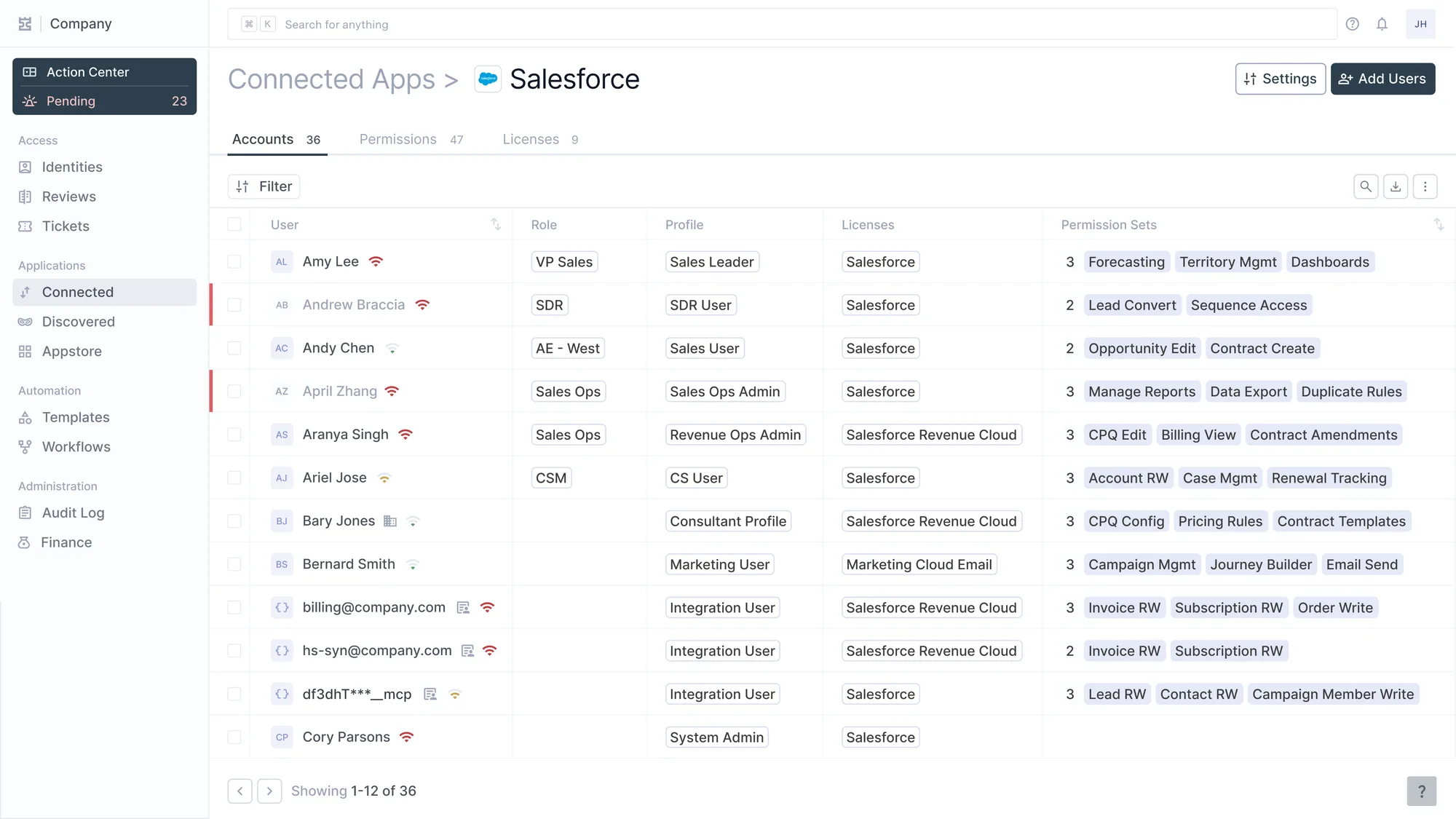
One app's accounts. billing@, hs-syn@ and an MCP integration user are in the list with everybody else, carrying the same profiles and permission sets.
Everything above is built on that. Without one place where every actor has a history, behavioural scope is a monitoring feature rather than an access decision.